

Updated Aug 04, 2025 ARA-C01 Exam Dumps - PDF Questions and Testing Engine
New (2025) Snowflake ARA-C01 Exam Dumps
NEW QUESTION # 44
What are some of the characteristics of result set caches? (Choose three.)
- A. Time Travel queries can be executed against the result set cache.
- B. The data stored in the result cache will contribute to storage costs.
- C. Snowflake persists the data results for 24 hours.
- D. The result set cache is not shared between warehouses.
- E. The retention period can be reset for a maximum of 31 days.
- F. Each time persisted results for a query are used, a 24-hour retention period is reset.
Answer: C,E,F
Explanation:
Comprehensive and Detailed Explanation: According to the SnowPro Advanced: Architect documents and learning resources, some of the characteristics of result set caches are:
* Snowflake persists the data results for 24 hours. This means that the result set cache holds the results of every query executed in the past 24 hours, and can be reused if the same query is submitted again and the underlying data has not changed1.
* Each time persisted results for a query are used, a 24-hour retention period is reset. This means that the result set cache extends the lifetime of the results every time they are reused, up to a maximum of 31 days from the date and time that the query was first executed1.
* The retention period can be reset for a maximum of 31 days. This means that the result set cache will purge the results after 31 days, regardless of whether they are reused or not. After 31 days, the next time the query is submitted, a new result is generated and persisted1.
The other options are incorrect because they are not characteristics of result set caches. Option A is incorrect because Time Travel queries cannot be executed against the result set cache. Time Travel queries use the AS OF clause to access historical data that is stored in the storage layer, not the result set cache2. Option D is incorrect because the data stored in the result set cache does not contribute to storage costs. The result set cache is maintained by the service layer, and does not incur any additional charges1. Option F is incorrect because the result set cache is shared between warehouses. The result set cache is available across virtual warehouses, so query results returned to one user are available to any other user on the system who executes the same query, provided the underlying data has not changed1. References: Using Persisted Query Results | Snowflake Documentation, Time Travel | Snowflake Documentation
NEW QUESTION # 45
A retail company has over 3000 stores all using the same Point of Sale (POS) system. The company wants to deliver near real-time sales results to category managers. The stores operate in a variety of time zones and exhibit a dynamic range of transactions each minute, with some stores having higher sales volumes than others.
Sales results are provided in a uniform fashion using data engineered fields that will be calculated in a complex data pipeline. Calculations include exceptions, aggregations, and scoring using external functions interfaced to scoring algorithms. The source data for aggregations has over 100M rows.
Every minute, the POS sends all sales transactions files to a cloud storage location with a naming convention that includes store numbers and timestamps to identify the set of transactions contained in the files. The files are typically less than 10MB in size.
How can the near real-time results be provided to the category managers? (Select TWO).
- A. The copy into command with a task scheduled to run every second should be used to achieve the near-real time requirement.
- B. All files should be concatenated before ingestion into Snowflake to avoid micro-ingestion.
- C. An external scheduler should examine the contents of the cloud storage location and issue SnowSQL commands to process the data at a frequency that matches the real-time analytics needs.
- D. A stream should be created to accumulate the near real-time data and a task should be created that runs at a frequency that matches the real-time analytics needs.
- E. A Snowpipe should be created and configured with AUTO_INGEST = true. A stream should be created to process INSERTS into a single target table using the stream metadata to inform the store number and timestamps.
Answer: A,E
NEW QUESTION # 46
A Snowflake Architect is setting up database replication to support a disaster recovery plan. The primary database has external tables.
How should the database be replicated?
- A. Create a clone of the primary database then replicate the database.
- B. Move the external tables to a database that is not replicated, then replicate the primary database.
- C. Replicate the database ensuring the replicated database is in the same region as the external tables.
- D. Share the primary database with an account in the same region that the database will be replicated to.
Answer: B
Explanation:
Database replication is a feature that allows you to create a copy of a database in another account, region, or cloud platform for disaster recovery or business continuity purposes. However, not all database objects can be replicated. External tables are one of the exceptions, as they reference data files stored in an external stage that is not part of Snowflake. Therefore, to replicate a database that contains external tables, you need to move the external tables to a separate database that is not replicated, and then replicate the primary database that contains the other objects. This way, you can avoid replication errors and ensure consistency between the primary and secondary databases. The other options are incorrect because they either do not address the issue of external tables, or they use an alternative method that is not supported by Snowflake. You cannot create a clone of the primary database and then replicate it, as replication only works on the original database, not on its clones. You also cannot share the primary database with another account, as sharing is a different feature that does not create a copy of the database, but rather grants access to the shared objects. Finally, you do not need to ensure that the replicated database is in the same region as the external tables, as external tables can access data files stored in any region or cloud platform, as long as the stage URL is valid and accessible. References:
* [Replication and Failover/Failback] 1
* [Introduction to External Tables] 2
* [Working with External Tables] 3
* [Replication : How to migrate an account from One Cloud Platform or Region to another in Snowflake] 4
NEW QUESTION # 47
You are creating a TASK to query a table streams created on the raw table and insert subsets of rows into multiple tables. You are following the below steps, but when you reached the step to resume the task, you received an error message as below.
Why is this error thrown and who can give you the required privilege?
Steps to be followed to get this error
-- Create a landing table to store raw JSON data.
-- Snowpipe could load data into this table. create or replace table raw (var variant);
-- Create a stream to capture inserts to the landing table.
-- A task will consume a set of columns from this stream. create or replace stream rawstream1 on table raw;
-- Create a second stream to capture inserts to the landing table.
-- A second task will consume another set of columns from this stream. create or replace stream rawstream2 on table raw;
-- Create a table that stores the names of office visitors identified in the raw data. create or replace table names (id int, first_name string, last_name string);
-- Create a table that stores the visitation dates of office visitors identified in the raw data.
create or replace table visits (id int, dt date);
-- Create a task that inserts new name records from the rawstream1 stream into the names table
-- every minute when the stream contains records.
-- Replace the 'mywh' warehouse with a warehouse that your role has USAGE privilege on. create or replace task raw_to_names
warehouse = etl_wh
schedule = '1 minute'
when
system$stream_has_data('rawstream1')
as
merge into names n
using (select var:id id, var:fname fname, var:lname lname from rawstream1) r1 on n.id = to_number(r1.id)
when matched then update set n.first_name = r1.fname, n.last_name = r1.lname
when not matched then insert (id, first_name, last_name) values (r1.id, r1.fname, r1.lname)
;
-- Create another task that merges visitation records from the rawstream1 stream into the visits table
-- every minute when the stream contains records.
-- Records with new IDs are inserted into the visits table;
-- Records with IDs that exist in the visits table update the DT column in the table.
-- Replace the 'mywh' warehouse with a warehouse that your role has USAGE privilege on. create or replace task raw_to_visits
warehouse = etl_wh schedule = '1 minute' when
system$stream_has_data('rawstream2') as
merge into visits v
using (select var:id id, var:visit_dt visit_dt from rawstream2) r2 on v.id = to_number(r2.id) when matched then update set v.dt = r2.visit_dt
when not matched then insert (id, dt) values (r2.id, r2.visit_dt);
-- Resume both tasks.
alter task raw_to_names resume;
- A. The role used to resume the task does not have EXECUTE TASK privilege. Only ACCOUNTADMIN can provide that privilege to the role.
- B. The role used to resume the task does not have EXECUTE TASK privilege. Only TASK OWNER can provide that privilege to the role.
- C. The role used to resume the task does not have EXECUTE TASK privilege. Both SECURITYADMIN and ACCOUNTADMIN can provide that privilege to the role.
Answer: A
NEW QUESTION # 48
There are two databases in an account, named fin_db and hr_db which contain payroll and employee data, respectively. Accountants and Analysts in the company require different permissions on the objects in these databases to perform their jobs. Accountants need read-write access to fin_db but only require read-only access to hr_db because the database is maintained by human resources personnel.
An Architect needs to create a read-only role for certain employees working in the human resources department.
Which permission sets must be granted to this role?
- A. USAGE on database hr_db, USAGE on all schemas in database hr_db, SELECT on all tables in database hr_db
- B. USAGE on database hr_db, USAGE on all schemas in database hr_db, REFERENCES on all tables in database hr_db
- C. USAGE on database hr_db, SELECT on all schemas in database hr_db, SELECT on all tables in database hr_db
- D. MODIFY on database hr_db, USAGE on all schemas in database hr_db, USAGE on all tables in database hr_db
Answer: A
Explanation:
To create a read-only role for certain employees working in the human resources department, the role needs to have the following permissions on the hr_db database:
USAGE on the database: This allows the role to access the database and see its schemas and objects.
USAGE on all schemas in the database: This allows the role to access the schemas and see their objects.
SELECT on all tables in the database: This allows the role to query the data in the tables.
Option A is the correct answer because it grants the minimum permissions required for a read-only role on the hr_db database.
Option B is incorrect because SELECT on schemas is not a valid permission. Schemas only support USAGE and CREATE permissions.
Option C is incorrect because MODIFY on the database is not a valid permission. Databases only support USAGE, CREATE, MONITOR, and OWNERSHIP permissions. Moreover, USAGE on tables is not sufficient for querying the data. Tables support SELECT, INSERT, UPDATE, DELETE, TRUNCATE, REFERENCES, and OWNERSHIP permissions.
Option D is incorrect because REFERENCES on tables is not relevant for querying the data. REFERENCES permission allows the role to create foreign key constraints on the tables.
Reference:
1: https://docs.snowflake.com/en/user-guide/security-access-control-privileges.html#database-privileges
2: https://docs.snowflake.com/en/user-guide/security-access-control-privileges.html#schema-privileges
3: https://docs.snowflake.com/en/user-guide/security-access-control-privileges.html#table-privileges
NEW QUESTION # 49
Why might a Snowflake Architect use a star schema model rather than a 3NF model when designing a data architecture to run in Snowflake? (Select TWO).
- A. The Architect is designing a landing zone to receive raw data into Snowflake.
- B. Snowflake cannot handle the joins implied in a 3NF data model.
- C. The Architect wants to remove data duplication from the data stored in Snowflake.
- D. The Architect wants to present a simple flattened single view of the data to a particular group of end users.
- E. The Bl tool needs a data model that allows users to summarize facts across different dimensions, or to drill down from the summaries.
Answer: D,E
Explanation:
A star schema model is a type of dimensional data model that consists of a single fact table and multiple dimension tables. A 3NF model is a type of relational data model that follows the third normal form, which eliminates data redundancy and ensures referential integrity. A Snowflake Architect might use a star schema model rather than a 3NF model when designing a data architecture to run in Snowflake for the following reasons:
* A star schema model is more suitable for analytical queries that require aggregating and slicing data across different dimensions, such as those performed by a BI tool. A 3NF model is more suitable for transactional queries that require inserting, updating, and deleting individual records.
* A star schema model is simpler and faster to query than a 3NF model, as it involves fewer joins and less complex SQL statements. A 3NF model is more complex and slower to query, as it involves more joins and more complex SQL statements.
* A star schema model can provide a simple flattened single view of the data to a particular group of end
* users, such as business analysts or data scientists, who need to explore and visualize the data. A 3NF model can provide a more detailed and normalized view of the data to a different group of end users, such as application developers or data engineers, who need to maintain and update the data.
The other options are not valid reasons for choosing a star schema model over a 3NF model in Snowflake:
* Snowflake can handle the joins implied in a 3NF data model, as it supports ANSI SQL and has a powerful query engine that can optimize and execute complex queries efficiently.
* The Architect can use both star schema and 3NF models to remove data duplication from the data stored in Snowflake, as both models can enforce data integrity and avoid data anomalies. However, the trade-off is that a star schema model may have more data redundancy than a 3NF model, as it denormalizes the data for faster query performance, while a 3NF model may have less data redundancy than a star schema model, as it normalizes the data for easier data maintenance.
* The Architect can use both star schema and 3NF models to design a landing zone to receive raw data into Snowflake, as both models can accommodate different types of data sources and formats. However, the choice of the model may depend on the purpose and scope of the landing zone, such as whether it is a temporary or permanent storage, whether it is a staging area or a data lake, and whether it is a single source or a multi-source integration.
References:
* Snowflake Architect Training
* Data Modeling: Understanding the Star and Snowflake Schemas
* Data Vault vs Star Schema vs Third Normal Form: Which Data Model to Use?
* Star Schema vs Snowflake Schema: 5 Key Differences
* Dimensional Data Modeling - Snowflake schema
* Star schema vs Snowflake Schema
NEW QUESTION # 50
A global company needs to securely share its sales and Inventory data with a vendor using a Snowflake account.
The company has its Snowflake account In the AWS eu-west 2 Europe (London) region. The vendor's Snowflake account Is on the Azure platform in the West Europe region. How should the company's Architect configure the data share?
- A. 1. Create a new role called db_share.
2. Grant the db_share role privileges to read data from the company database and schema.
3. Create a user for the vendor.
4. Grant the ds_share role to the vendor's users. - B. 1. Promote an existing database in the company's local account to primary.
2. Replicate the database to Snowflake on Azure in the West-Europe region.
3. Create a share and add objects to the share.
4. Add a consumer account to the share for the vendor to access. - C. 1. Create a share.
2. Add objects to the share.
3. Add a consumer account to the share for the vendor to access. - D. 1. Create a share.
2. Create a reader account for the vendor to use.
3. Add the reader account to the share.
Answer: C
Explanation:
The correct way to securely share data with a vendor using a Snowflake account on a different cloud platform and region is to create a share, add objects to the share, and add a consumer account to the share for the vendor to access. This way, the company can control what data is shared, who can access it, and how long the share is valid. The vendor can then query the shared data without copying or moving it to their own account. The other options are either incorrect or inefficient, as they involve creating unnecessary reader accounts, users, roles, or database replication.
https://learn.snowflake.com/en/certifications/snowpro-advanced-architect/
NEW QUESTION # 51
An Architect is using SnowCD to investigate a connectivity issue.
Which system function will provide a list of endpoints that the network must be able to access to use a specific Snowflake account, leveraging private connectivity?
- A. SYSTEMSGET_PRIVATELINK
- B. SYSTEMSAUTHORIZE_PRIVATELINK
- C. SYSTEMSALLOWLIST ()
- D. SYSTEMSALLOWLIST_PRIVATELINK ()
Answer: D
NEW QUESTION # 52
Company A has recently acquired company B.
The Snowflake deployment for company B is located in the Azure West Europe region.
As part of the integration process, an Architect has been asked to consolidate company B's sales data into company A's Snowflake account which is located in the AWS us-east-1 region.
How can this requirement be met?
- A. Migrate company B's Snowflake deployment to the same region as company A's Snowflake deployment, ensuring data locality. Then perform a direct database-to-database merge of the sales data.
- B. Export the sales data from company B's Snowflake account as CSV files, and transfer the files to company A's Snowflake account. Import the data using Snowflake's data loading capabilities.
- C. Replicate the sales data from company B's Snowflake account into company A's Snowflake account using cross-region data replication within Snowflake. Configure a direct share from company B's account to company A's account.
- D. Build a custom data pipeline using Azure Data Factory or a similar tool to extract the sales data from company B's Snowflake account. Transform the data, then load it into company A's Snowflake account.
Answer: C
Explanation:
The best way to meet the requirement of consolidating company B's sales data into company A's Snowflake account is to use cross-region data replication within Snowflake. This feature allows data providers to securely share data with data consumers across different regions and cloud platforms. By replicating the sales data from company B's account in Azure West Europe region to company A's account in AWS us-east-1 region, the data will be synchronized and available for consumption. To enable data replication, the accounts must be linked and replication must be enabled by a user with the ORGADMIN role. Then, a replication group must be created and the sales database must be added to the group. Finally, a direct share must be configured from company B's account to company A's account to grant access to the replicated data. This option is more efficient and secure than exporting and importing data using CSV files or migrating the entire Snowflake deployment to another region or cloud platform. It also does not require building a custom data pipeline using external tools.
Reference:
Sharing data securely across regions and cloud platforms
Introduction to replication and failover
Replication considerations
Replicating account objects
NEW QUESTION # 53
Which data models can be used when modeling tables in a Snowflake environment? (Select THREE).
- A. Data lake
- B. Dimensional/Kimball
- C. lnmon/3NF
- D. Data vault
- E. Bayesian hierarchical model
- F. Graph model
Answer: B,C,D
Explanation:
Snowflake is a cloud data platform that supports various data models for modeling tables in a Snowflake environment. The data models can be classified into two categories: dimensional and normalized. Dimensional data models are designed to optimize query performance and ease of use for business intelligence and analytics. Normalized data models are designed to reduce data redundancy and ensure data integrity for transactional and operational systems. The following are some of the data models that can be used in Snowflake:
* Dimensional/Kimball: This is a popular dimensional data model that uses a star or snowflake schema to organize data into fact and dimension tables. Fact tables store quantitative measures and foreign keys to dimension tables. Dimension tables store descriptive attributes and hierarchies. A star schema has a single denormalized dimension table for each dimension, while a snowflake schema has multiple normalized dimension tables for each dimension. Snowflake supports both star and snowflake schemas, and allows users to create views and joins to simplify queries.
* Inmon/3NF: This is a common normalized data model that uses a third normal form (3NF) schema to organize data into entities and relationships. 3NF schema eliminates data duplication and ensures data consistency by applying three rules: 1) every column in a table must depend on the primary key, 2)
* every column in a table must depend on the whole primary key, not a part of it, and 3) every column in a table must depend only on the primary key, not on other columns. Snowflake supports 3NF schema and allows users to create referential integrity constraints and foreign key relationships to enforce data quality.
* Data vault: This is a hybrid data model that combines the best practices of dimensional and normalized data models to create a scalable, flexible, and resilient data warehouse. Data vault schema consists of three types of tables: hubs, links, and satellites. Hubs store business keys and metadata for each entity.
Links store associations and relationships between entities. Satellites store descriptive attributes and historical changes for each entity or relationship. Snowflake supports data vault schema and allows users to leverage its features such as time travel, zero-copy cloning, and secure data sharing to implement data vault methodology.
References: What is Data Modeling? | Snowflake, Snowflake Schema in Data Warehouse Model - GeeksforGeeks, [Data Vault 2.0 Modeling with Snowflake]
NEW QUESTION # 54
The following DDL command was used to create a task based on a stream: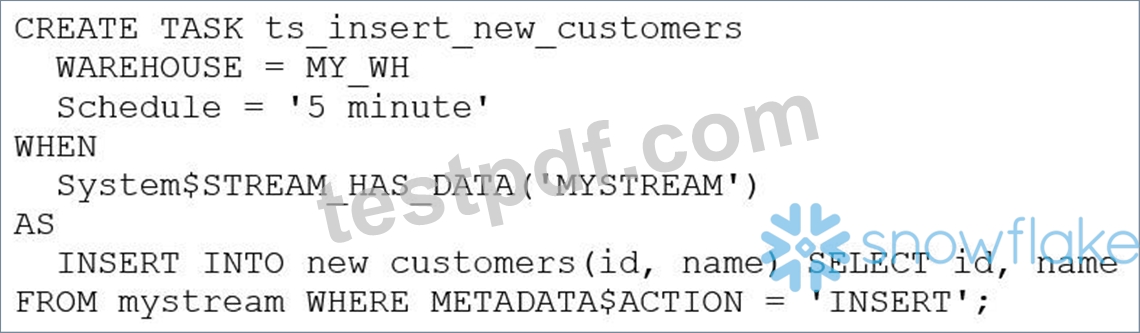
Assuming MY_WH is set to auto_suspend - 60 and used exclusively for this task, which statement is true?
- A. The warehouse MY_WH will only be active when there are results in the stream.
- B. The warehouse MY_WH will never suspend.
- C. The warehouse MY_WH will automatically resize to accommodate the size of the stream.
- D. The warehouse MY_WH will be made active every five minutes to check the stream.
Answer: D
NEW QUESTION # 55
What built-in Snowflake features make use of the change tracking metadata for a table? (Choose two.)
- A. The CHANGES clause
- B. A STREAM object
- C. The UPSERT command
- D. The MERGE command
- E. TheCHANGE_DATA_CAPTURE command
Answer: A,B
Explanation:
Explanation
The built-in Snowflake features that make use of the change tracking metadata for a table are the CHANGES clause and a STREAM object. The CHANGES clause enables querying the change tracking metadata for a table or view within a specified interval of time without having to create a stream with an explicit transactional offset1. A STREAM object records data manipulation language (DML) changes made to tables, including inserts, updates, and deletes, as well as metadata about each change, so that actions can be taken using the changed data. This process is referred to as change data capture (CDC)2. The other options are incorrect because they do not make use of the change tracking metadata for a table. The MERGE command performs insert, update, or delete operations on a target table based on the results of a join with a source table3. The UPSERT command is not a valid Snowflake command. The CHANGE_DATA_CAPTURE command is not a valid Snowflake command. References: CHANGES | Snowflake Documentation, Change Tracking Using Table Streams | Snowflake Documentation, MERGE | Snowflake Documentation
NEW QUESTION # 56
An Architect needs to allow a user to create a database from an inbound share.
To meet this requirement, the user's role must have which privileges? (Choose two.)
- A. CREATE DATABASE;
- B. IMPORT SHARE;
- C. IMPORT PRIVILEGES;
- D. IMPORT DATABASE;
- E. CREATE SHARE;
Answer: A,D
Explanation:
Explanation
According to the Snowflake documentation, to create a database from an inbound share, the user's role must have the following privileges:
* The CREATE DATABASE privilege on the current account. This privilege allows the user to create a new database in the account1.
* The IMPORT DATABASE privilege on the share. This privilege allows the user to import a database from the share into the account2. The other privileges listed are not relevant for this requirement. The IMPORT SHARE privilege is used to import a share into the account, not a database3. The IMPORT PRIVILEGES privilege is used to import the privileges granted on the shared objects, not the objects themselves2. The CREATE SHARE privilege is used to create a share to provide data to other accounts, not to consume data from other accounts4.
References:
* CREATE DATABASE | Snowflake Documentation
* Importing Data from a Share | Snowflake Documentation
* Importing a Share | Snowflake Documentation
* CREATE SHARE | Snowflake Documentation
NEW QUESTION # 57
Following objects can be cloned in snowflake
- A. Permanent table
- B. Internal stages
- C. Transient table
- D. Temporary table
- E. External tables
Answer: A,C,E
Explanation:
* Snowflake supports cloning of various objects, such as databases, schemas, tables, stages, file formats, sequences, streams, tasks, and roles. Cloning creates a copy of an existing object in the system without copying the data or metadata. Cloning is also known as zero-copy cloning1.
* Among the objects listed in the question, the following ones can be cloned in Snowflake:
* Permanent table: A permanent table is a type of table that has a Fail-safe period and a Time Travel retention period of up to 90 days. A permanent table can be cloned using the CREATE TABLE ...
CLONE command2. Therefore, option A is correct.
* Transient table: A transient table is a type of table that does not have a Fail-safe period and can have a Time Travel retention period of either 0 or 1 day. A transient table can also be cloned using the CREATE TABLE ... CLONE command2. Therefore, option B is correct.
* External table: An external table is a type of table that references data files stored in an external
* location, such as Amazon S3, Google Cloud Storage, or Microsoft Azure Blob Storage. An external table can be cloned using the CREATE EXTERNAL TABLE ... CLONE command3.
Therefore, option D is correct.
* The following objects listed in the question cannot be cloned in Snowflake:
* Temporary table: A temporary table is a type of table that is automatically dropped when the session ends or the current user logs out. Temporary tables do not support cloning4. Therefore, option C is incorrect.
* Internal stage: An internal stage is a type of stage that is managed by Snowflake and stores files in Snowflake's internal cloud storage. Internal stages do not support cloning5. Therefore, option E is incorrect.
References: : Cloning Considerations : CREATE TABLE ... CLONE : CREATE EXTERNAL TABLE ...
CLONE : Temporary Tables : Internal Stages
NEW QUESTION # 58
What is a key consideration when setting up search optimization service for a table?
- A. Search optimization service can significantly improve query performance on partitioned external tables.
- B. The table must be clustered with a key having multiple columns for effective search optimization.
- C. Search optimization service can help to optimize storage usage by compressing the data into a GZIP format.
- D. Search optimization service works best with a column that has a minimum of 100 K distinct values.
Answer: D
Explanation:
Search optimization service is a feature of Snowflake that can significantly improve the performance of certain types of lookup and analytical queries on tables. Search optimization service creates and maintains a persistent data structure called a search access path, which keeps track of which values of the table's columns might be found in each of its micro-partitions, allowing some micro-partitions to be skipped when scanning the table1.
Search optimization service can significantly improve query performance on partitioned external tables, which are tables that store data in external locations such as Amazon S3 or Google Cloud Storage. Partitioned external tables can leverage the search access path to prune the partitions that do not contain the relevant data, reducing the amount of data that needs to be scanned and transferred from the external location2.
The other options are not correct because:
A) Search optimization service works best with a column that has a high cardinality, which means that the column has many distinct values. However, there is no specific minimum number of distinct values required for search optimization service to work effectively. The actual performance improvement depends on the selectivity of the queries and the distribution of the data1.
C) Search optimization service does not help to optimize storage usage by compressing the data into a GZIP format. Search optimization service does not affect the storage format or compression of the data, which is determined by the file format options of the table. Search optimization service only creates an additional data structure that is stored separately from the table data1.
D) The table does not need to be clustered with a key having multiple columns for effective search optimization. Clustering is a feature of Snowflake that allows ordering the data in a table or a partitioned external table based on one or more clustering keys. Clustering can improve the performance of queries that filter on the clustering keys, as it reduces the number of micro-partitions that need to be scanned. However, clustering is not required for search optimization service to work, as search optimization service can skip micro-partitions based on any column that has a search access path, regardless of the clustering key3.
Reference:
1: Search Optimization Service | Snowflake Documentation
2: Partitioned External Tables | Snowflake Documentation
3: Clustering Keys | Snowflake Documentation
NEW QUESTION # 59
A company has several sites in different regions from which the company wants to ingest data.
Which of the following will enable this type of data ingestion?
- A. The company should use a storage integration for the external stage.
- B. The company must replicate data between Snowflake accounts.
- C. The company should provision a reader account to each site and ingest the data through the reader accounts.
- D. The company must have a Snowflake account in each cloud region to be able to ingest data to that account.
Answer: A
Explanation:
Explanation
This is the correct answer because it allows the company to ingest data from different regions using a storage integration for the external stage. A storage integration is a feature that enables secure and easy access to files in external cloud storage from Snowflake. A storage integration can be used to create an external stage, which is a named location that references the files in the external storage. An external stage can be used to load data into Snowflake tables using the COPY INTO command, or to unload data from Snowflake tables using the COPY INTO LOCATION command. A storage integration can support multiple regions and cloud platforms, as long as the external storage service is compatible with Snowflake12.
References:
* Snowflake Documentation: Storage Integrations
* Snowflake Documentation: External Stages
NEW QUESTION # 60
The Data Engineering team at a large manufacturing company needs to engineer data coming from many sources to support a wide variety of use cases and data consumer requirements which include:
1) Finance and Vendor Management team members who require reporting and visualization
2) Data Science team members who require access to raw data for ML model development
3) Sales team members who require engineered and protected data for data monetization What Snowflake data modeling approaches will meet these requirements? (Choose two.)
- A. Create a raw database for landing and persisting raw data entering the data pipelines.
- B. Create a Data Vault as the sole data pipeline endpoint and have all consumers directly access the Vault.
- C. Create a set of profile-specific databases that aligns data with usage patterns.
- D. Create a single star schema in a single database to support all consumers' requirements.
- E. Consolidate data in the company's data lake and use EXTERNAL TABLES.
Answer: A,C
Explanation:
Explanation
These two approaches are recommended by Snowflake for data modeling in a data lake scenario. Creating a raw database allows the data engineering team to ingest data from various sources without any transformation or cleansing, preserving the original data quality and format. This enables the data science team to access the raw data for ML model development. Creating a set of profile-specific databases allows the data engineering team to apply different transformations and optimizations for different use cases and data consumer requirements. For example, the finance and vendor management team can access a dimensional database that supports reporting and visualization, while the sales team can access a secure database that supports data monetization.
References:
* Snowflake Data Lake Architecture | Snowflake Documentation
* Snowflake Data Lake Best Practices | Snowflake Documentation
NEW QUESTION # 61
Please select the correct hierarchy from below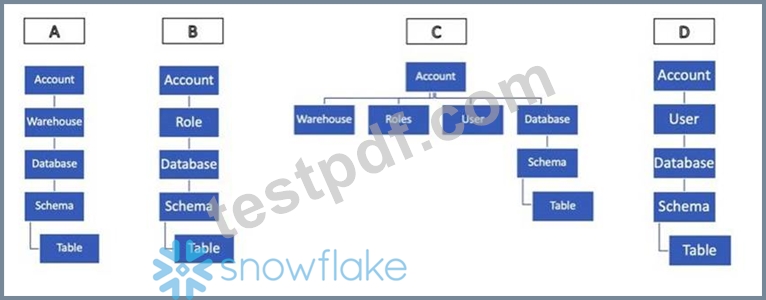
- A. Option D
- B. Option A
- C. Option C
- D. Option B
Answer: C
NEW QUESTION # 62
What is the MOST efficient way to design an environment where data retention is not considered critical, and customization needs are to be kept to a minimum?
- A. Use a transient table.
- B. Use a transient database.
- C. Use a transient schema.
- D. Use a temporary table.
Answer: B
NEW QUESTION # 63
......
Updated Verified Pass ARA-C01 Exam - Real Questions and Answers: https://braindumps.testpdf.com/ARA-C01-practice-test.html
